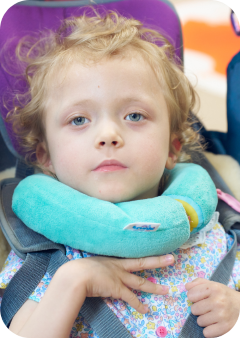
Philip spoke about his granddaughter Penelope (pictured), who turns four next month and sadly has a “cruel” degenerative genetic condition with a short life expectancy.
“She used to be able to sit up, crawl and would be very giggly,” he said. “Now she’s lost a lot of that. It’s heartbreaking.”
He described the impact on Penelope’s older sister too, and how she’d learned to become a little carer. “That’s their norm,” he said. “But that’s not normal for other children.”
His wife Cathy shared how life has changed in unexpected ways. “I’m always thinking of things that Pen can do with her elbow because she loves to knock things with it,” she smiled. “You start to look at things in a different way.”
She also spoke about living between sadness and hope. “I find myself getting upset but then I think, no – today she’s okay, today she’s smiling. You do need to cry sometimes though.”
Sue described having a grandchild with a life-limiting condition as “a double kick.”
“You’re grieving for your grandchild, which is heartbreaking, and it’s also the pain that your child is going through. You desperately want to help them both.”
Like others in the room, she spoke about systems that can feel impossible to navigate. “There’s such a fight to get the help you need. Your children have to tell their story over and over again. It’s soul destroying.”
Beth and Riki recognised every word. Their grandson Noah, nearly 18 months old, was born with a rare and life-limiting condition. Holding Riki’s hand, Beth shared their grandson’s story: “He won’t ever be able to walk or talk. But he can smile and he can giggle. His smile is absolutely everything.”
Beth left her job so she could help care for Noah and support her daughter.
“I love looking after Noah. I'm always looking for things he can play with – dried pasta, lights, anything shiny. That’s the only way I can feel useful,” she said. “I can’t make him better. But I can make it slightly easier.”
She described how isolating life can feel. “You don’t know any other grandparents living a similar life. It’s nice to talk with other people here, who understand what it’s like to support your own child and your grandchild, who are going through such pain and who you love equally and differently.”
Linda shared stories of her 10-year-old granddaughter Addy, who has a degenerative condition called Batten disease.
“She's lost a lot of the skills she had, so she can only sit up a little bit now. It’s really hard. I love how spunky she is though. And that smile — oh my goodness, that smile and that giggle,” she said. “She’s the most loving child.”
She praised the support offered by Julia’s House to siblings and parents too. “It’s fantastic that it’s a whole family support from Julia’s House which is really amazing. It’s not just the child, it’s every member who is supported and I really appreciate that
For Lisa, whose grandson Finley died in January, Grandmates offered a safe space to share her experience, and she spoke movingly of the precious time her daughter could share with Finley in the hospice after his death.
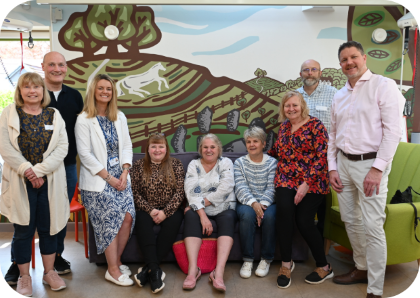
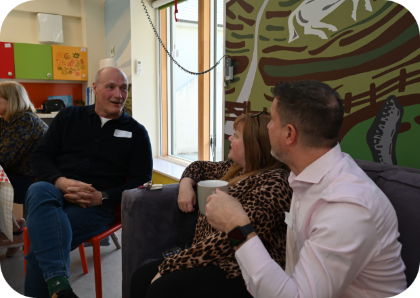
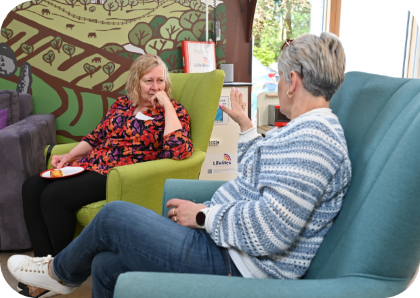
Throughout the afternoon there were tears, but there was laughter too – funny memories, shared moments and the comfort of being with people who know what you’re going through.
As Sue put it: “There is a relief in sharing with people who understand.”